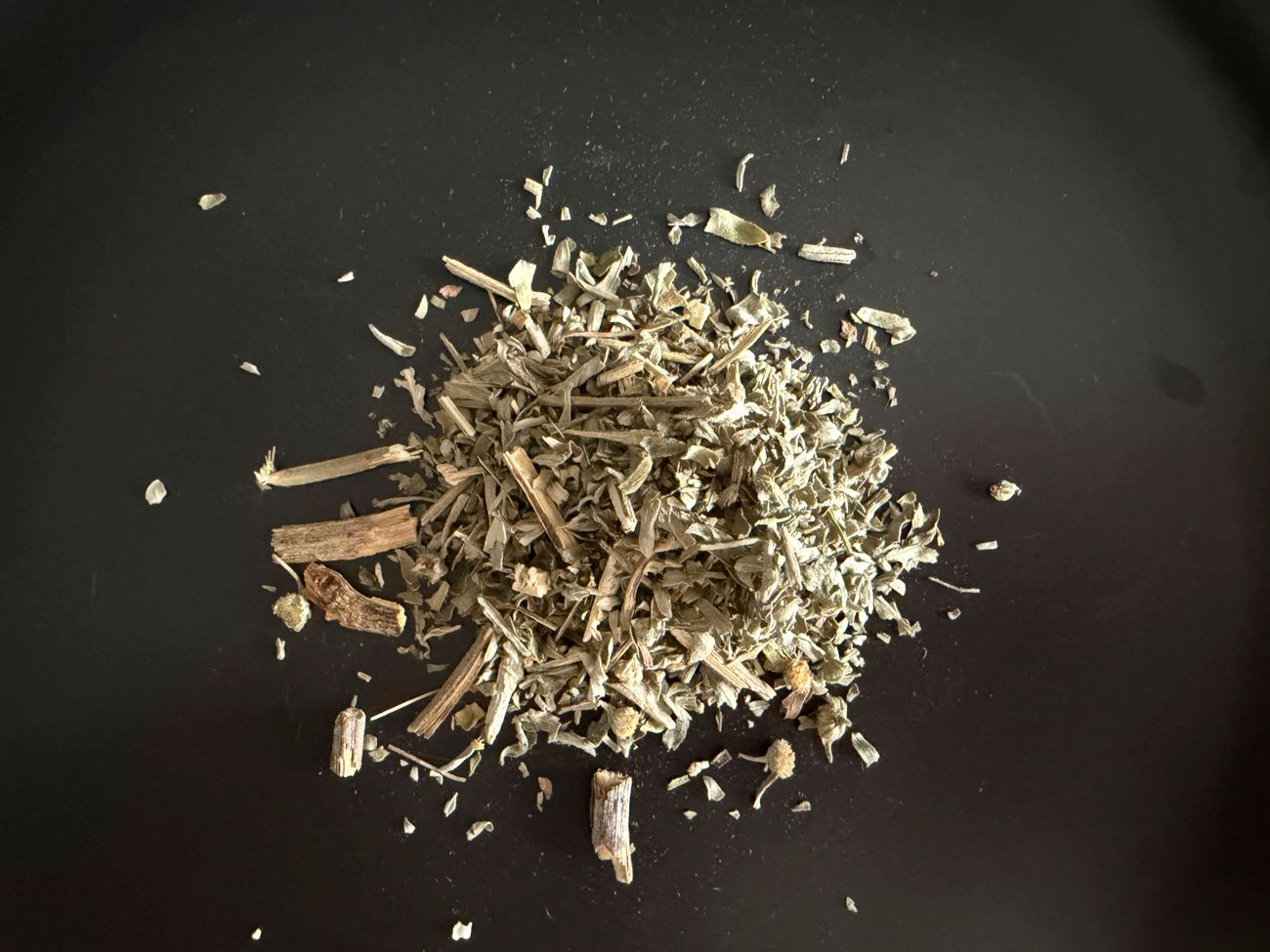
Wormwood is the herb behind absinthe and vermouth. It's one of the most bitter plants used in drinks, and vermouth gets its name from Wermut, the German word for wormwood. Botanically it's Artemisia absinthium, a silvery-leaved plant in the same family as tarragon and mugwort.
Like gentian, wormwood is a bittering agent, meaning the herb that supplies the bitterness in a blend. But it comes with real cautions that gentian doesn't, so read the safety section before you use it.
What wormwood tastes like
Wormwood's flavor is intensely bitter, with a strong herbal, green character and an earthy, almost medicinal edge. There's a faint floral note underneath, but the bitterness and the green herbal taste come first. It's sharper and more complicated than gentian's clean bitterness, which is why it reads as the signature taste of absinthe and vermouth.
First-hand note. My single-herb wormwood tincture was sharply bitter (a 4 on my 0–5 scale), with strong herbal, green notes (4) and an earthy, woody base (4) under it, plus a faint floral edge (3). The smell was earthy and herbal both times I tasted it. I scored it at 5 drops.
How to use it in bitters
Wormwood is a supporting bittering herb, not usually the base. It adds bitterness plus a green, slightly medicinal complexity, and a small amount brings depth and an absinthe-like edge. Too much takes over.
In the formulator it's an assertive accent. Think of it as a seasoning, measured in a small fraction of the blend, not the backbone. It pairs with gentian and orange peel.
Where to buy it
Buy dried, cut wormwood (Artemisia absinthium) from a reputable herb supplier, and check it's labeled with that botanical name so you know you have the right species. You want the dried herb, not an essential oil or extract. A little goes a long way, so the smallest bag will last a while.
A note on safety
Wormwood needs more care than the other herbs on this site. Skip it, or talk to a professional first, if any of these apply:
- Don't use it if you're pregnant or breastfeeding. Wormwood has traditionally been used to bring on menstruation, and it's advised against in pregnancy.
- Avoid it if you have epilepsy or a seizure disorder. Wormwood contains thujone, a compound that can trigger seizures in high enough amounts.
- Never put wormwood essential oil in a drink. The oil is where thujone concentrates, and it isn't safe to ingest.
Thujone is the compound behind wormwood's old reputation. The amount in a few dashes of homemade bitters is small, and regulators cap how much thujone a drink can contain for exactly this reason. Even so, use wormwood sparingly.
None of this is medical advice, and it isn't a complete list. If you take any medication regularly or have a health condition, run it by your pharmacist or a drug-interaction checker before using wormwood as anything more than an occasional cocktail bitter.
Traditional uses
Wormwood is one of the classic European digestive bitters. The EMA recognizes it as a traditional herbal medicinal product for temporary loss of appetite and mild digestive complaints like bloating and indigestion. That's based on long-standing use rather than modern clinical trials. The idea is the same one behind most bitters: the bitter taste itself is thought to stimulate appetite and digestion.
That's traditional use, not proven benefit. On this site, wormwood earns its place as a flavor and as a piece of cocktail history. Its medicinal past is context, not a health claim.
Where you've already had it
If you've had a Negroni, a Manhattan, or a Martini, you've tasted wormwood. It's in the vermouth in all of them.
Sources
- European Medicines Agency — Absinthii herba (Artemisia absinthium L., herba): herbal medicinal product. https://www.ema.europa.eu/en/medicines/herbal/absinthii-herba
- European Medicines Agency — Public statement on the use of herbal medicinal products containing thujone. https://www.ema.europa.eu/en/documents/scientific-guideline/public-statement-use-herbal-medicinal-products-containing-thujone-revision-1_en.pdf